Keeping things simple
In which a deuterocanonical author talks at some length about how he's going to be brief.

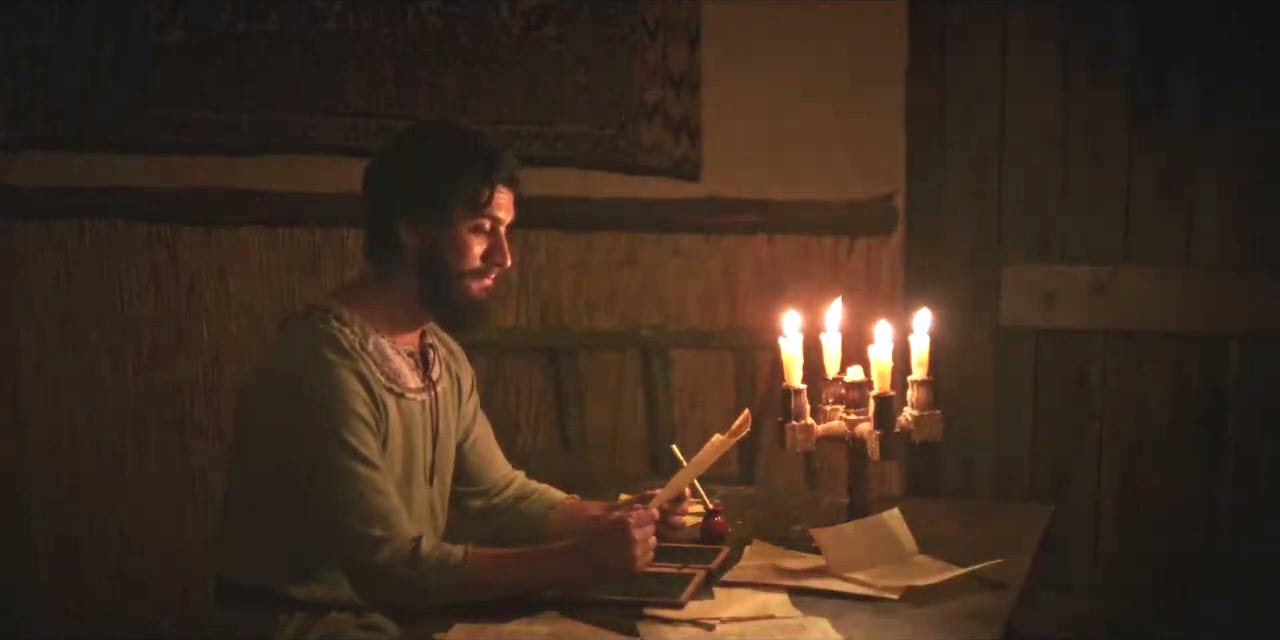
Just a quick note to say I’ve been reading I & II Maccabees as I prep the next Chosen episode analysis, and I think I’ve found a kindred spirit.
From the “author’s preface” (as the Good News Translation puts it) in II Maccabees 2:19-32 (emphasis added, natch):
19 Jason of Cyrene has recorded in five volumes the story of Judas Maccabeus and his brothers, the purification of the great Temple, and the dedication of its altar. 20 He has described the battles with Antiochus Epiphanes and with his son Eupator, 21 and he has told of the heavenly visions that appeared to those who fought bravely and enthusiastically to defend Judaism. Our forces were few in number, but they plundered the entire country and routed the heathen forces. 22 They recaptured the Temple famous throughout the world, liberated Jerusalem, and restored the laws that were in danger of being abolished. They were able to do all these things because the Lord was merciful and kind to them.
23 I will now try to summarize in a single book the five volumes written by Jason. 24 The number of details and the bulk of material can be overwhelming for anyone who wants to read an account of the events. 25 But I have attempted to simplify it for all readers; those who read for sheer pleasure will find enjoyment and those who want to memorize the facts will not find it difficult. 26 Writing such a summary is a difficult task, demanding hard work and sleepless nights. 27 It is as difficult as preparing a banquet that people of different tastes will enjoy. But I am happy to undergo this hardship in order to please my readers. 28 I will leave the matter of details to the original author and attempt to give only a summary of the events. 29 I am not the builder of a new house who is concerned with every detail of the structure, but simply a painter whose only concern is to make the house look attractive. 30 The historian must master his subject, examine every detail, and then explain it carefully, 31 but whoever is merely writing a summary should be permitted to give a brief account without going into a detailed discussion. 32 So then, without any further comment, I will begin my story. It would be foolish to write such a long introduction that the story itself would have to be cut short.
I burst out laughing when I read the bit about “sleepless nights”.
And the part about “preparing a banquet that people of different tastes will enjoy”—including “those who read for sheer pleasure” and “those who want to memorize the facts”—really resonated with me. This is basically what I try to do with my Chosen recaps: I try to write for people who are new to certain topics, and I also try to write for people who are familiar with certain topics but maybe haven’t thought about them from certain angles before—and I try to do it in as brisk and informative a style as possible, without getting overly weighed down by the details.
It can be a tricky balancing act—especially if, like me, you see lots of connections between things and you instinctively want to point them all out—and yes, I sometimes go to sleep at night wondering how I’ll tackle the challenge in the morning.
It also amuses me that the author of II Maccabees spent so much time explaining his approach—with metaphors about banquets and painting houses, and no fewer than five references to the “details” he’s skipping—that he had to remind himself not to make his intro too long. It can be very easy sometimes to talk about the way you talk about something, but sometimes you just have to talk about the thing itself.
One last thought: I appreciate the fact that the author of II Maccabees acknowledges his source material, but what did Jason of Cyrene think of this book? (I assume he didn’t authorize it.) And how would Jason feel about the fact that this summary of his work can now be found in Bibles all over the world, while his own five-volume work is lost?
