
Season 4, Episode 7 — ‘The Last Sign’
John 11
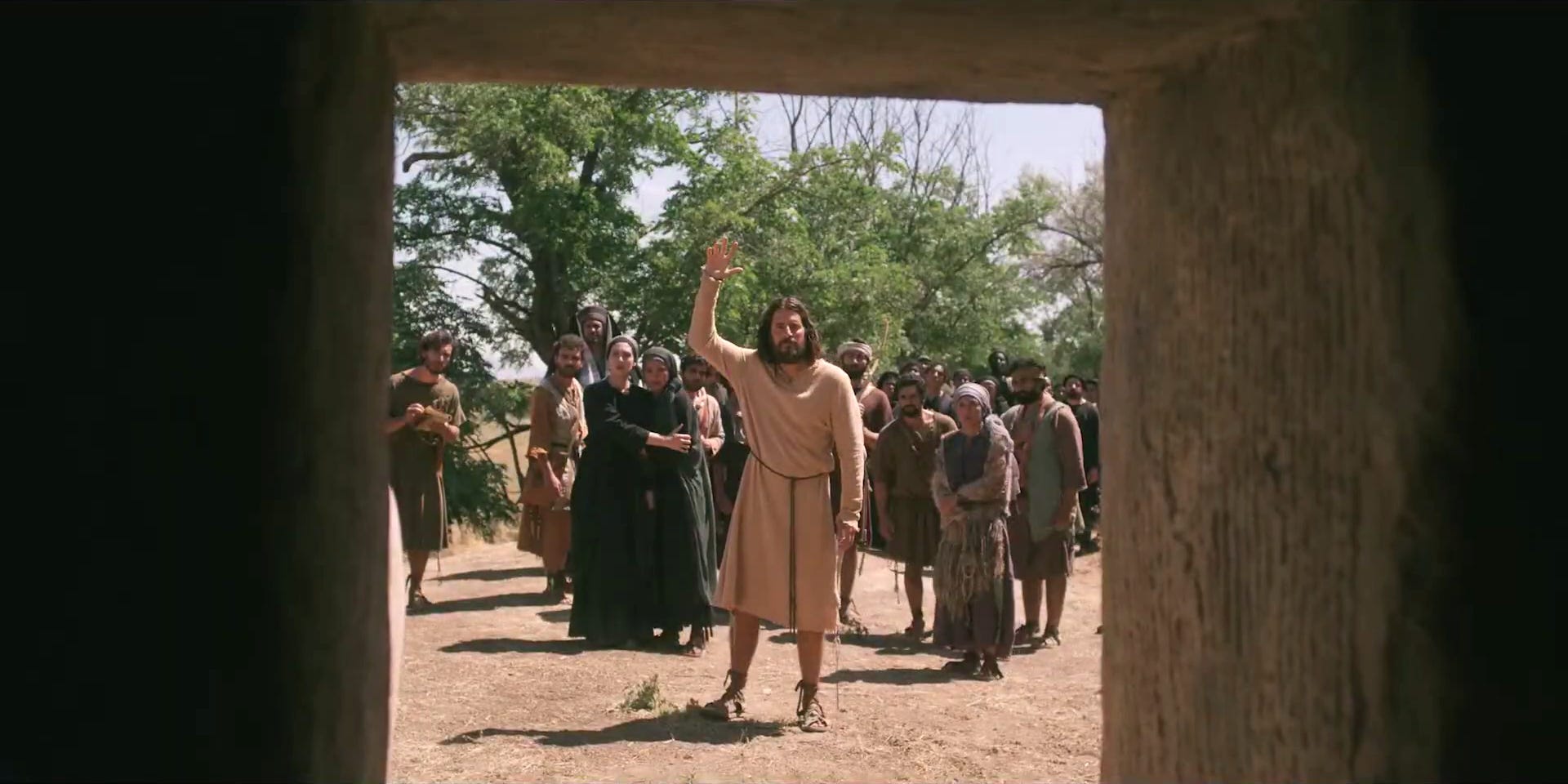
Synopsis. At some point in the future, circa AD 60, Matthew visits Mary Magdalene in a cave in France and shows her his newly-completed gospel. Back in the present, Jesus and the disciples walk to Bethany. Martha greets them outside the village, and then her sister Mary joins them. Jesus—troubled by the sisters’ grief, by his disciples’ lack of understanding, and by his own impending death—falls to his knees and sobs. The sisters take him to their brother’s tomb, and there he raises Lazarus. Thomas, still grieving the death of Ramah, reacts to the miracle very badly, and wonders why Jesus couldn’t have raised Ramah too. Jesus tells Lazarus the miracle he performed that day will be his last public sign. Circa AD 60, Mary Magdalene reads Matthew a “psalm” she has written, in which she offers her interpretation of these events.
-
Gospels. This episode features the raising of Lazarus (John 11:17-44), along with a bit of the aftermath of that miracle (John 11:45-46).
-
The raising-of-Lazarus scenes follow John’s gospel pretty closely, but they also add some extra dialogue, partly to flesh out the characters’ emotions.
The biblical Martha said to Jesus, “Lord, if you had been here, my brother would not have died. But I know that even now God will give you whatever you ask” (John 11:21-22). I have always thought that these words reflect the same frank practicality that Martha demonstrated when she asked Jesus why he wasn’t telling Mary to help her serve their guests (Luke 10:40). But in this episode, these two sentences are separated by extra sentences in which Martha says she’s “trying not to be angry” with Jesus—because he didn’t come as soon as he heard about Lazarus’s sickness—and Jesus replies that she’s “confused and devastated”. (The biblical Martha had less to be angry about, because Lazarus would have died no matter how quickly Jesus came to Bethany. More on that in a minute.)
After Martha says God will give Jesus whatever he asks for, she adds that Jesus can still do something to give them “hope or relief”.
Martha says she knows her brother will rise again in the resurrection at the end of the age (John 11:24). She then adds, perhaps bitterly, that that’s “a long time to wait.”
Jesus says he’s “the resurrection and the life”, and Martha says she believes he is the Christ (John 11:25-27). He then replies, “That’s all I need for now.”
Martha goes back to the house to get Mary (John 11:28), and Matthew and Peter ask Jesus if they’re supposed to be understanding what he just said, and Jesus sighs and replies, “I suppose not yet.”
The biblical Jesus was “deeply moved in spirit and troubled” when he saw Mary of Bethany weeping and all the people with her, and he wept too (John 11:33, 35). The Jesus of this episode sees not just Mary and the people with her, but looks around at his mother and disciples, and then he falls to the ground and sobs—overwhelmed not just by the weeping of Lazarus’s sister but by the fact that he, too, is going to suffer and die and his disciples don’t understand it yet.
In the biblical account, the people with the sisters said Jesus had opened the eyes of the blind, so why couldn’t he have prevented Lazarus from dying? (John 11:37) In the episode, it is Andrew who asks this question—and he asks if Jesus is “mad” at the disciples.
After Lazarus comes comes out of the tomb, Jesus semi-apologizes for letting him die in the first place. Jesus says he’s “sorry it had to be this way, but also not, because there is a higher plan in all of it.”
Thomas, still mourning the death of Ramah, reacts very, very badly when he realizes that Jesus does have the power to raise the dead but didn’t use it to save Ramah. Jesus tells him that what God allows “can be crushing for you, and yes, even for me,” and he says it “hurts my heart” to see Thomas suffer like this.
For more on these added elements, see ‘Themes’ and ‘Humanization’ below.
-
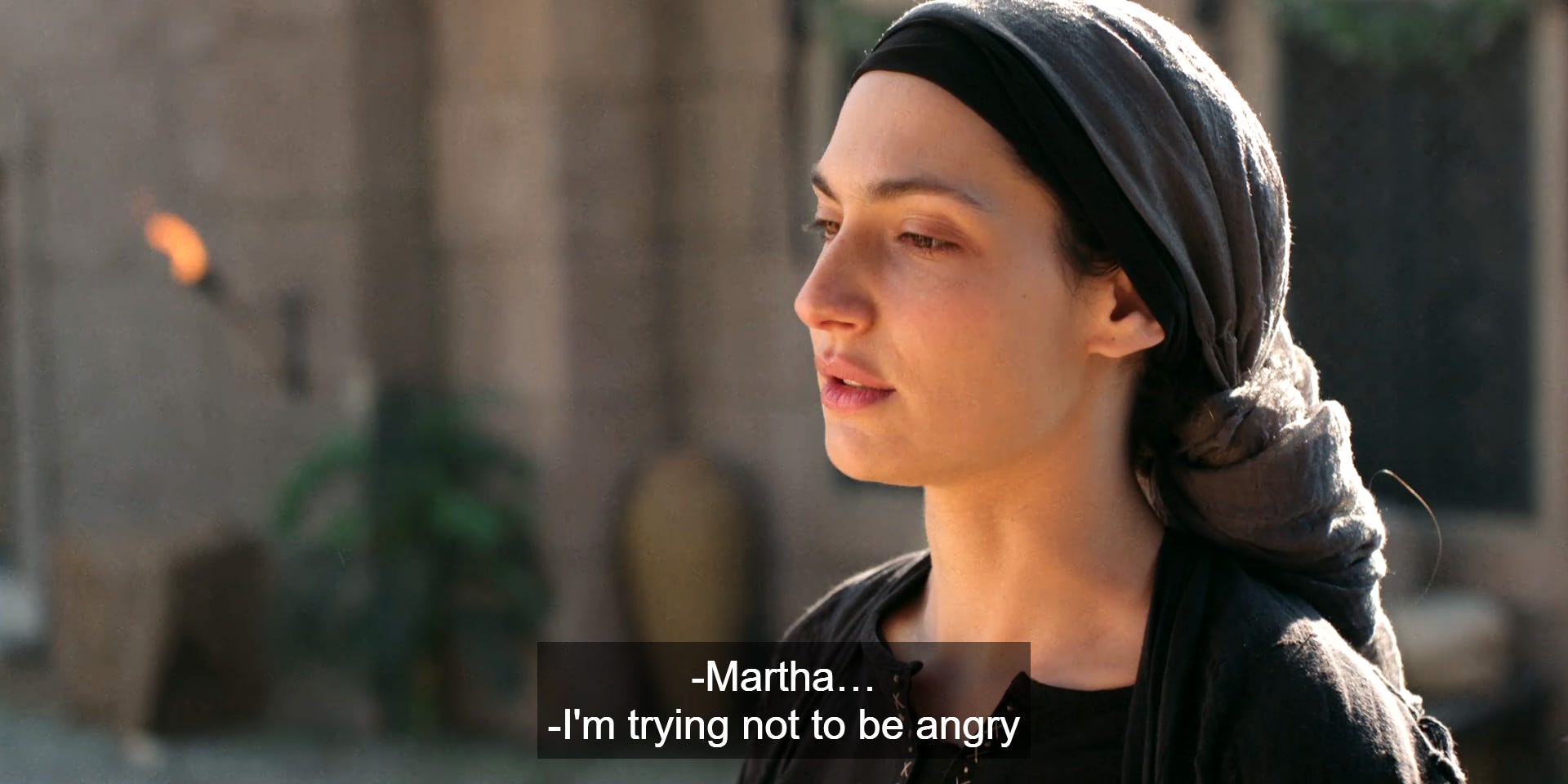
Martha is angry that Jesus didn’t come sooner and prevent Lazarus’s death. Later, Jesus “confesses” to Lazarus that he did not come to Bethany as soon as he could have.
The characters seems to be assuming that Jesus could have prevented Lazarus’s death if he had responded to the sisters’ message as soon as he got it. It’s not clear that that’s the case in the gospel, though.
The biblical Jesus waited only two days after hearing that Lazarus was sick before telling the disciples they were going back to Judea (John 11:6-7), and when they got to Bethany, they learned that Lazarus had been dead and buried for four days already (John 11:17). Presumably if they’d left for Judea right away, Lazarus still would have been dead and buried when they got there—just for only two days, instead.
I assume travel time, which The Chosen often doesn’t take into account, has something to do with the biblical timeline here: it would have taken time for the message to reach Jesus in the first place, and it would have taken time for Jesus and the disciples to walk back to Bethany once they decided to go there.
So why did Jesus wait the extra two days? What was the point in delaying his journey, if Lazarus was going to be dead anyway? I assume he needed Lazarus to be really, really dead—four days dead, odour-coming-out-of-the-tomb dead—so that everyone would believe he had truly raised someone from the dead and not just resuscitated someone who only appeared to be dead.
It may also be significant that there is a Jewish tradition which says the soul of a dead person hovers near the body for three days, hoping to re-enter it, and then it leaves the body for good once the “aura” or “radiance” of the person’s face changes, i.e. once the body’s decomposition starts to become obvious (Genesis Rabbah 100.1, Leviticus Rabbah 18.1). I have no idea if this tradition goes back to Jesus’ time, but if it does, the raising of Lazarus after four days would have shown that Jesus had power over death even after a person’s spirit had given up on returning to the body.
